
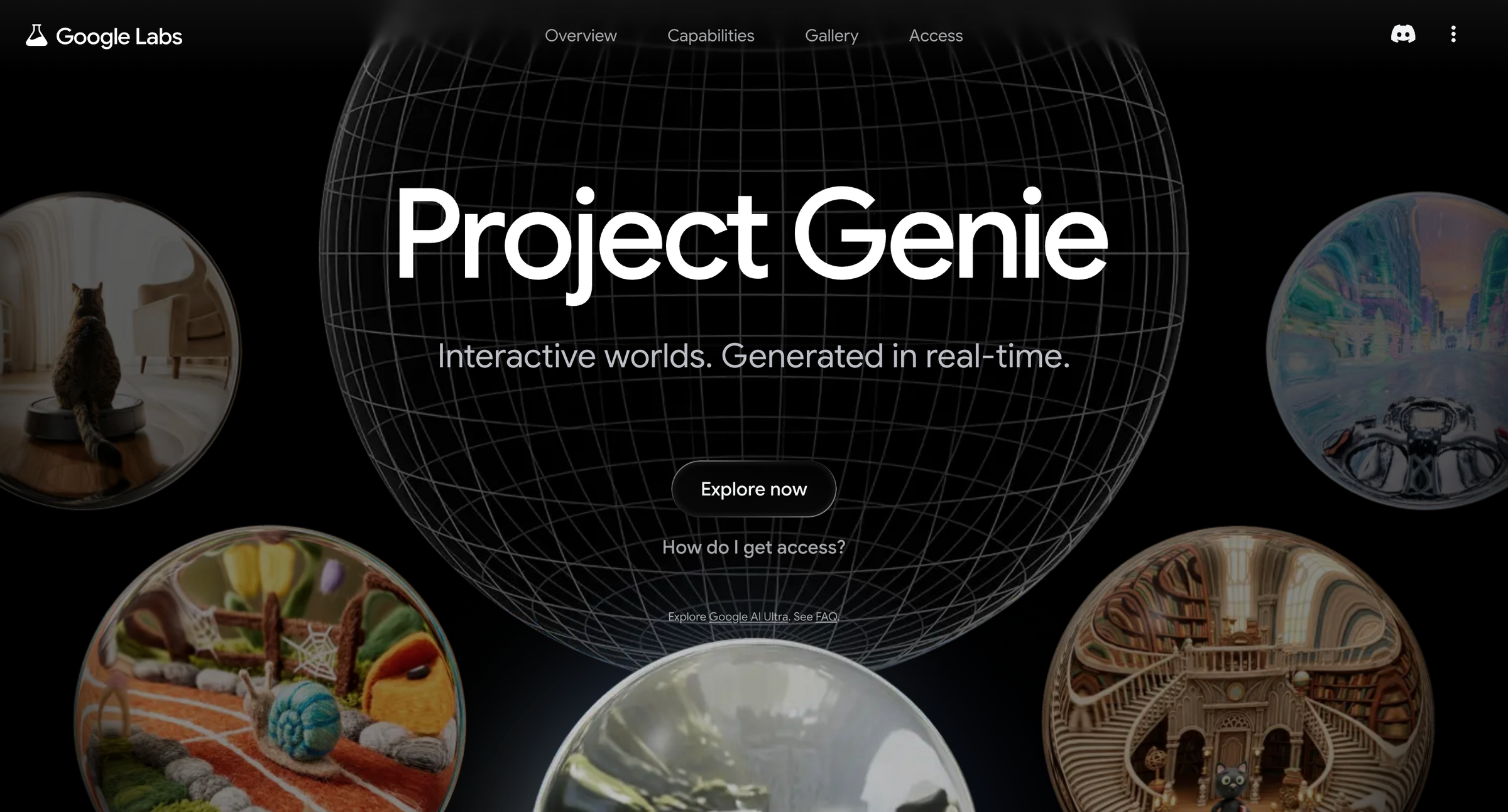
Google’s Project Genie: What It Really Is, What It Isn’t, and Why the Internet Is Debating It
When Google researchers quietly published details about Project Genie, an experimental artificial intelligence system developed by Google DeepMind, the internet reaction was swift and polarized. Headlines and social posts quickly framed Genie as everything from an “AI game engine” to a potential threat to game developers. The reality, however, is far more measured — and far more interesting — than the hype suggests.
Project Genie is not a product announcement, nor is it a roadmap for replacing game engines or human creators. Instead, it is a research project that explores how artificial intelligence can learn interactive environments purely from visual data. While that distinction has been lost in some online discussions, it is central to understanding why Project Genie matters — and why, for most users, it doesn’t yet change anything at all.
What Project Genie Actually Does
According to Google DeepMind’s official research release, Project Genie is a world-model AI capable of generating simple, playable two-dimensional environments after being trained on gameplay video. Rather than relying on hard-coded rules, Genie learns how a world behaves by observing how objects move and respond to player input across thousands of frames of footage.
In demonstrations shared by DeepMind, Genie produces environments where a player can move a character, interact with obstacles, and experience basic cause-and-effect reactions. The system predicts what should happen next based on patterns it has learned, effectively simulating a rudimentary game world without explicit programming.
Google describes this work as part of its broader effort to create generalist AI systems that can understand and interact with complex environments. The original research and technical explanation can be found directly on DeepMind’s official blog, which emphasizes that Genie is an experimental model, not a finished tool.
What Project Genie Is Not
Despite viral interpretations, Project Genie is not a replacement for traditional game engines such as Unreal Engine or Unity. It does not generate narratives, assets, multiplayer systems, or polished gameplay loops. The environments it produces are abstract, visually simple, and limited in scope.
More importantly, Genie does not “design” games. It does not understand balance, player engagement, storytelling, or creativity. It predicts interactions based on learned visual correlations, not intent. This distinction separates research prototypes like Genie from tools used in real-world development.
Google has also made no announcement suggesting that Project Genie will become a consumer product, a developer SDK, or a feature integrated into existing Google platforms. There is no timeline for public access, and no indication that it will be monetized.
Why Project Genie Has Researchers Paying Attention
While Project Genie may not impact players or developers today, it represents a meaningful step in AI environment modeling, a field with implications beyond games. World models like Genie could eventually help train AI systems to navigate virtual spaces, simulate real-world scenarios, or understand interactive media at a deeper level.
For Google, this research aligns with broader initiatives around multimodal AI, where systems learn from images, video, audio, and interaction rather than text alone. Similar ideas underpin Google’s work on Gemini and other experimental AI projects.
Experts note that understanding environments — not just language — is a critical milestone for advancing artificial intelligence. In that context, Project Genie is less about entertainment and more about foundational AI research.
Why Some Users Are Skeptical
Online reactions to Project Genie have been mixed, particularly among gaming communities. On platforms like Reddit and X, some users expressed concern that projects like Genie signal a future where AI replaces creative labor. Others criticized the media coverage itself, arguing that experimental research is being misrepresented as a near-term disruption.
These concerns are not entirely unfounded, but they often overlook the gap between research and application. As several developers pointed out in community discussions, the leap from a basic 2D simulation to a commercially viable game is enormous. For now, Project Genie remains firmly in the research phase.
Why Project Genie May Never Matter to Most People
For everyday users, Project Genie changes nothing about how games are made, played, or purchased. It does not affect current development pipelines, business models, or creative workflows. Many AI research projects never leave the lab, and even fewer reach consumers in recognizable form.
That does not diminish the importance of the work, but it does place it in proper context. Project Genie is best understood as a proof of concept, not a preview of imminent change.
A Broader Pattern in AI Coverage
The reaction to Project Genie highlights a recurring pattern in AI discourse: early-stage research is often framed as immediate disruption. In reality, breakthroughs tend to influence products gradually, sometimes invisibly, over many years.
By clearly distinguishing what Project Genie is and is not, Google’s research serves as a reminder that progress in artificial intelligence is often incremental, experimental, and uncertain — even when it captures public imagination.
For now, Project Genie stands as a fascinating research milestone rather than a turning point. Whether it eventually shapes consumer technology or remains a stepping stone for future models will depend on developments still far beyond the horizon.
